
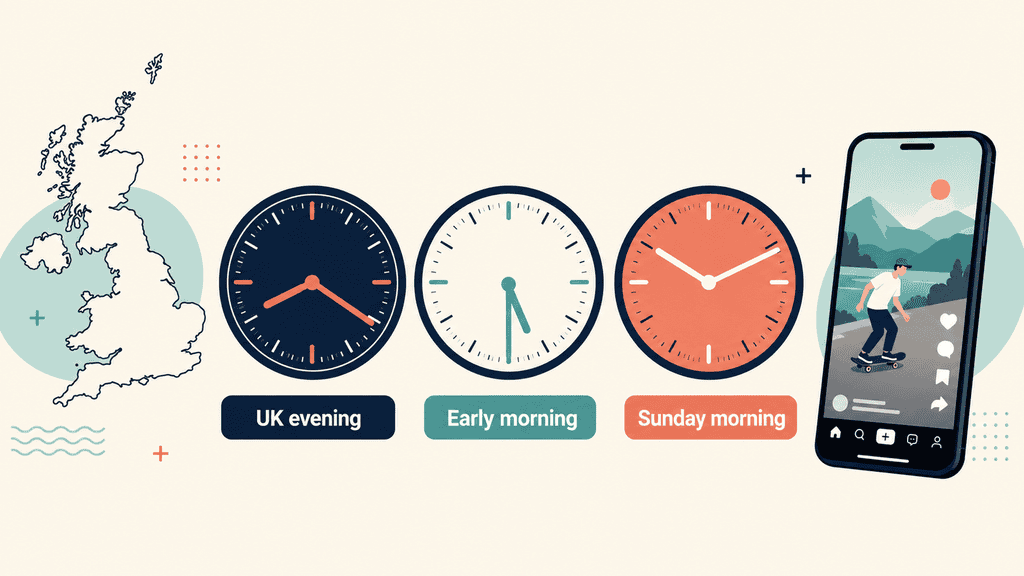
The best time to post on TikTok UK is not one proven hour for every account. For a useful first test, publish at 7pm on Thursday by the UK clock. Compare that with 9am on Sunday and one scheduled post between 5am and 6am.
Why those best times? Large 2026 studies disagree. Sprout Social’s UK data favours weekday evenings. Dash Social’s UK brand sample points to early morning. Buffer’s wider study puts Sunday at 9am first.
That disagreement is useful. It shows why a universal TikTok posting schedule can mislead. Each study examines a different group, metric and time zone.
Your own TikTok Analytics should make the final decision. Use the research below as a starting point, then test when your audience is most active. These best times help UK creators and small businesses begin an experiment; they do not replace account data.
Best time to post on TikTok UK: the short answer
If you want a simple UK posting schedule to test, start here:
- One post a week: Thursday at 7pm
- Two posts a week: Thursday at 7pm and Sunday at 9am
- Three posts a week: add a weekday post between 5am and 6am
- Best broad weekday period: late afternoon to late evening
- Best weekend challenger: Sunday morning
- Best method: compare these windows with your own follower activity
All three suggestions use the time shown on a UK clock. That means 7pm remains 7pm whether Britain is on GMT or BST.
However, some research reports times in GMT. Check the source’s method before copying any posting times into a scheduling tool.
The best time to post is the slot that works repeatedly for your goal. The best times below give the experiment a credible starting point.
Four TikTok posting-time studies compared
The table below explains why four current guides produce different answers.
| Source | Sample and market | What it measured | Main finding | Main limitation |
|---|---|---|---|---|
| Sprout Social | 25 million UK TikTok engagements | Engagement across UK brand accounts | Thursday led; Wednesday was strong from 3pm to 11pm; Monday and Thursday ran from 4pm to midnight | Times are stated in GMT, so a BST conversion may be needed |
| Dash Social | More than 33,000 posts from 137 UK brands | Average engagement rate by hour | 5am to 6am led with a 5.9% rate | A high rate does not prove the largest number of users was online |
| Buffer | 7.1 million posts across a wider market | Median engagement rate | Sunday at 9am ranked first; Saturday ranked as the strongest day | The result is not UK-only |
| Hopper HQ | UK guide; sample size not stated on the inspected page | Recommended UK posting windows | 7am–9am, noon–2pm and 7pm–10pm; Friday led | Without a stated sample size, the findings carry less evidential weight |
The studies do not cancel each other out. They answer different questions, so they report different best times.
Why the studies disagree
They examine different accounts
Sprout Social and Dash Social analyse brand activity. Buffer studies a much wider set of TikTok posts.
A fashion brand, a football creator and a news publisher will attract different viewers. Their daily routines will also differ. A single posting time will not fit every niche or target audience. Audience demographics, location and content preferences all shape the optimal times for a specific audience. Those optimal times may change as the account grows.
They use different measures of success
Engagement volume and engagement rate are not the same.
A busy evening might produce more total views, likes, comments and shares. However, a quiet early-morning slot could record a higher engagement rate because fewer brands post then. That can make the best times for maximum engagement different from the best times for the largest audience.
Choose the metric that matches the job:
- A publisher may focus on reach, watch time and profile visits.
- A retailer may track saves, product clicks and purchases.
- A creator may value follows per 1,000 views.
- A local business may care about enquiries from people in its service area.
Their clocks do not always mean the same thing
Sprout Social states that its UK times are shown in GMT. Buffer says its data is normalised so users do not need to convert it. Hopper HQ uses the time shown on a British clock.
Dash Social presents a UK segment, but its relevant section does not clearly settle the clock basis. Therefore, treat its 5am to 6am finding as a window to test and check the time-zone setting in your own tools.
The datasets cover different periods
User habits change. School terms, holidays, live sport, television schedules and seasonal daylight can all affect TikTok activity. General trends across an entire week may hide a sudden peak caused by an event or viral sound.
The age of the audience matters too. Students, shift workers and office staff do not follow the same timetable.
Best time to post on TikTok UK by day
No study proves one UK winner for every day. The schedule below combines the strongest research signals into seven practical tests. It covers early mornings, a lunch break, late afternoon, early evening and late-night activity.
| Day | First UK local time to test | Reason for testing it |
|---|---|---|
| Monday | 6pm | Sits inside Sprout Social’s long Monday period |
| Tuesday | 7pm | Tests a normal weekday evening against your audience data |
| Wednesday | 5pm | Sits inside Sprout Social’s strong Wednesday period |
| Thursday | 7pm | Combines Sprout Social’s leading UK day with a usable evening hour |
| Friday | 6pm | Matches Buffer’s Friday result and sits near Hopper HQ’s evening period |
| Saturday | 5pm | Matches Buffer’s strongest Saturday hour |
| Sunday | 9am | Buffer’s leading individual time across 7.1 million posts |
These are starting points, not rules. If your TikTok profile shows a clear peak at another time, test that period first.
The content itself should also influence the choice. A breakfast recipe may fit early morning. A reaction to a television advert may work during or after the programme. Breaking news should normally go live once it has been checked, rather than waiting for a general peak.
The best time to post also changes with the subject. The best times for planned content may not suit news, live sport or fast-moving trends.
Best time to post on TikTok on Monday
The best time to post on TikTok on Monday is 6pm for this UK test. Sprout Social reports strong Monday engagement from late afternoon into the evening. If 6pm performs poorly, test 8pm before dropping Monday.
Monday may suit practical videos that help people plan the days ahead. Compare views, watch time and followers gained with the same metrics from Thursday.
Best time to post on TikTok on Tuesday
The best time to post on TikTok on Tuesday is 7pm as a first UK control. This slot lets you post on TikTok after the normal workday and compare it with a much earlier challenger.
Buffer’s wider research also reports strong Tuesday posting times in the early morning and late evening. Therefore, test 6am or 10pm if your followers are most active then.
Best time to post on TikTok on Wednesday
The best time to post on TikTok on Wednesday is 5pm for the first test. Sprout’s UK data shows a long period of activity from 3pm to 11pm GMT.
Because that period is wide, look for the right moment in your own analytics. A school-age audience may become active earlier than an audience of working professionals.
Best time to post on TikTok on Thursday
The best time to post on TikTok on Thursday is 7pm by the UK clock. Thursday is Sprout’s leading UK day, and its findings show engagement continuing late into the evening.
This is still an ideal posting time to challenge, not a guaranteed winner. Post consistently in the slot four times before comparing it with Sunday morning.
Best time to post on TikTok on Friday
The best time to post on TikTok on Friday is 6pm in this schedule. Buffer names 6pm as its leading Friday result, while Hopper HQ favours Friday evenings for TikTok UK.
Friday behaviour can vary sharply by age and niche. Test 9pm if your audience is online later, but do not assume every Friday night will deliver the best results.
Best time to post on TikTok on Saturday
The best time to post on TikTok on Saturday is 5pm according to Buffer’s broader analysis. Its study names Saturday as the strongest day overall, while Sprout identifies Saturday as the worst day in its UK brand data.
That conflict makes Saturday useful. It tests whether weekends bring a larger audience to your account or the lowest engagement of your posting schedule.
Best time to post on TikTok on Sunday
The best time to post on TikTok on Sunday is 9am in Buffer’s 7.1-million-post study. Sunday morning offers a clear alternative to weekday evening posting times.
Dash Social also finds late-night and early-morning engagement peaks in its global data. If your TikTok users are active later, compare 9am with 10pm rather than assuming one size fits all.
Best times to post for common UK audience routines
The best times to post are easier to choose when you start with audience behaviour. Use these as test ideas rather than fixed instructions.
| Audience routine | Best times to test | Why the timing may fit |
|---|---|---|
| School or college audience | 4pm–7pm | Viewers may be free after classes and travel |
| Office workers | Noon–2pm and 6pm–9pm | Lunch hours and the evening create more time for sound-on attention |
| Parents | 9am–11am and 8pm–10pm | Activity may rise after the school run or later at night |
| Retail shoppers | 6am–7am and 5pm–8pm | Dash Social reports an early retail peak; evening adds a practical challenger |
| Media and entertainment viewers | 7pm–midnight | Reactions and entertainment can match live viewing and late scrolling |
| Mixed UK and US audience | 6pm–8pm UK clock time | This reaches Britain in the evening and US Eastern users during the afternoon |
These best times do not apply to every account in each group. Your audience’s location and habits should decide which specific times remain in the plan.
Which best times should different accounts test?
The best time to post depends on the account’s goal and content. These suggestions turn broad activity patterns into useful challengers:
- Best times for B2B posts: test Tuesday to Thursday from 5pm to 8pm.
- Best times for local businesses: test lunch and the after-work period.
- Best times for retailers: compare 6am–7am with 5pm–8pm.
- Best times for publishers: compare the morning news period with late evening.
- Best times for entertainment: test 7pm–11pm when people have more viewing time.
- Best times for educational videos: compare lunch with 4pm–7pm.
- Best times for product demonstrations: test before work and after work.
- Best times for weekend content: compare Saturday at 5pm with Sunday at 9am.
- Best times for UK and US posts: begin with 6pm–8pm on a British clock.
- Best times for a new account: use three different slots until Analytics has enough activity to guide you.
These best times are not findings from one combined dataset. They are a practical testing list drawn from the activity patterns and limitations discussed above.
Does posting time matter on TikTok?
Posting time can help, but it will not rescue a weak TikTok video.
Publishing while more likely viewers are active may give a post the best chance to collect early views and interactions. Early engagement may improve content visibility, but TikTok does not publish a rule saying every video must hit a fixed engagement target in its first hour.
TikTok’s explanation of its For You recommendations says the system considers user interactions, video information and device or account information. Strong viewer response matters, but timing is only one part of that response. The TikTok algorithm does not select videos from posting time alone, and no public TikTok algorithm formula identifies one winning hour.
A clear opening, relevant subject and good viewer retention still carry more practical value than moving a poor post from 4pm to 7pm. Short form video demands fast, sound on attention, so viewers should understand the point within the opening seconds. People quickly scan for a reason to keep watching.
The best posting times change by industry
Dash Social’s category analysis shows how far posting times can move between audiences:
- Beauty brands led between 10pm and 11pm.
- Fashion brands led between 6am and 7am.
- Media brands led between 11pm and midnight.
- Retail brands led between 6am and 7am.
These results come from category-level samples, not a promise for every business. Use the closest industry window as a challenger against your general posting schedule. The best times for beauty, fashion, retail and media show how different TikTok based groups can behave.
Content type can create another split. Educational TikTok videos may suit lunch hours or early evening. Entertainment TikTok videos may perform later, when viewers have more time. Product TikTok videos may work near shopping or meal-planning periods.
The best times for one format may fail for another. Compare short tutorials, reactions and product videos separately before combining their results.
How to find your own best TikTok posting time
Open TikTok Studio and select Analytics. A creator or business account should have access, although menu labels can differ by account type and app version.
Some versions show a Followers tab, while others place similar information under viewers or audience. If a Followers tab appears, open it and find follower activity. Then compare those active times with the posting times in your Content tab.
Look for:
- days and hours when followers or viewers are active;
- top audience locations;
- average watch time;
- completion rate or average percentage watched;
- traffic sources;
- shares, saves and comments;
- profile views and follower growth.
Also record the total number of posts, follower growth and interactions during the test. Those numbers provide valuable insights when two time slots produce similar views.
The tallest activity bar is a clue. It does not prove that every topic will perform well in that slot. The best times in TikTok Analytics show when people are present, not which video they will choose to watch. Your audience’s location can also shift those peak posting times.
If your audience spans several countries, check locations before choosing a time. Other social media platforms may use a different audience pattern, so do not copy an Instagram schedule into TikTok Analytics. A 7pm London post reaches New York at 2pm for much of the year, but the gap briefly changes around the spring and autumn clock changes.
How to turn TikTok Analytics into optimal posting times
Start with the three periods when your followers are most active. Select one posting time inside each period and create a simple plan.
Next, review your strongest TikTok videos in the Content tab. Note the day, publishing hour, mean watch duration, engagement and audience location. Look for repeated patterns rather than one viral result.
Then compare the analytics with the research table. If your account peaks at 8pm, there is little reason to force a 5am post simply because one UK study found a high engagement rate then.
The best times are the periods that repeatedly support your goal. For maximum engagement, measure shares, saves and comments per 1,000 views. For awareness, watch reach, views and profile activity. For growth, compare follows and follower growth from each group.
Finally, update the posting schedule every month. Seasonal changes, a larger following and a change in content can move the optimal posting times. The best times should change when the evidence changes.
A four-week TikTok posting test
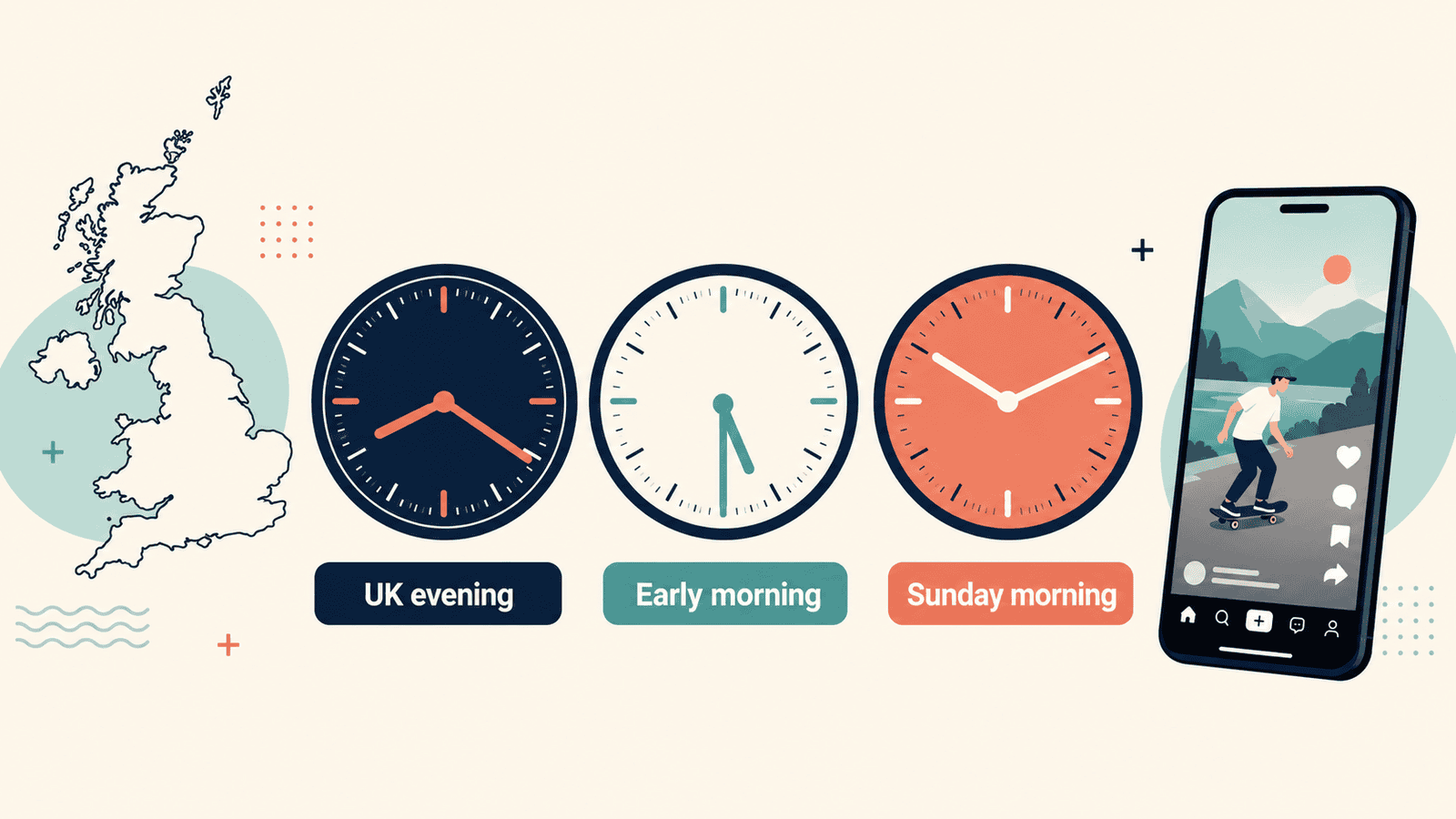
Use 12 comparable posts across three time slots. This timing experiment tests three different patterns without asking you to publish daily. The best time to post should win across several comparable uploads, not one lucky result:
| Test group | Posting time | Research signal being tested |
|---|---|---|
| A | Thursday at 7pm | UK weekday-evening activity |
| B | Sunday at 9am | Buffer’s weekend result |
| C | Tuesday between 5am and 6am | Dash Social’s UK early-morning result |
Publish four TikTok posts in each group. Keep the topic, format, video length and production standard as similar as practical. When you post on TikTok, use the same method of filming, editing and caption writing across all three groups. Hit publish at the planned hour and record any delay.
Measure every post after the same 24-hour period. Record:
- Views
- Average watch time
- Completion rate or average percentage watched
- Shares per 1,000 views
- Saves per 1,000 views
- Profile visits per 1,000 views
- New followers per 1,000 views
Compare the median for each group. The median is the middle result after the figures are placed in order. It reduces the effect of one viral post or one failure.
Do not choose the winner from likes alone. A slot that produces fewer views but more saves and followers may better support a specialist creator. A brand seeking awareness may prefer the slot with greater reach and content visibility. The best times should support more than one useful metric.
Run the winner for another month. Keep one challenger each week so the schedule can change as audience behaviour changes.
GMT, BST and scheduling TikTok posts in Britain
The UK uses GMT in winter and BST in summer. BST is one hour ahead of GMT.
For everyday publishing, set your local timezone to Europe/London where possible. It should then change automatically when the clocks move.
If a report states its findings in GMT, add one hour during BST. For example:
- 7pm GMT equals 7pm UK clock time in winter.
- 7pm GMT equals 8pm UK clock time during BST.
Do not convert a source that already uses the British clock. Hopper HQ’s UK timetable, for example, is written that way throughout the year.
Check the label shown in TikTok Analytics before converting activity data. Third-party guides disagree about how different versions handle time zones. The accessible TikTok Studio help material does not clearly settle that point for every account and app version. Check three time zones separately if large groups of followers live in three regions.
What if your TikTok audience is in the UK and US?
Start with the country that supplies the larger share of viewers. If Britain leads, keep the main post in a UK peak period.
The UK is usually five hours ahead of US Eastern Time. For short periods around the spring and autumn clock changes, the gap is four hours.
A 7pm UK post therefore reaches the US East Coast at about 2pm on most dates. That may suit a mixed audience, even though it misses the American evening peak.
If the same content must reach both markets, test one of these plans:
- Publish once during the stronger market’s peak.
- Create two edited versions and publish each for its own market.
- Use a UK evening slot and measure whether US views build later.
Avoid uploading identical posts within a short period merely to hit two clocks. A different opening, caption or edit gives each version a clearer reason to exist.
Marketing lesson: time is a distribution choice, not the idea
The disagreement between studies is the main marketing insight.
Timing advice often looks precise because a table gives an exact hour. However, that precision can hide differences in audience, metric and method. The best times only become useful when you know what “best” measures.
Use broad research to choose sensible experiments. Then let account-level evidence replace the general benchmark.
The strongest TikTok strategy is not “post every Thursday at 7pm”. It is:
- Publish content for a defined audience.
- Test several credible posting windows.
- Measure the outcome tied to the campaign goal.
- Keep the winning slot and continue testing.
Frequently asked questions
What is the best time to post on TikTok in the UK?
Thursday at 7pm UK local time is a sensible first test. Compare it with Sunday at 9am and an early-morning post between 5am and 6am. Your own analytics should decide the long-term winner.
What is the best day to post on TikTok in the UK?
Sprout Social’s UK-specific study names Thursday as the leading day. Buffer’s wider study names Saturday. The difference reflects separate markets, account groups and measures, so test both weekday and weekend activity.
Is 9pm a good time to post on TikTok UK?
It can be. Sprout Social records long evening periods for UK TikTok activity, while Hopper HQ recommends 7pm to 10pm. Check whether 9pm also matches your followers’ active times.
Should I post on TikTok in GMT or BST?
Schedule by UK local time and set tools to Europe/London when possible. If a source gives times in GMT, add one hour during BST. Do not add an hour when the source already uses UK local time.
How often should a business post on TikTok?
There is no useful frequency for every business. Choose a pace that allows consistent, worthwhile TikTok posts. Three weekly posts are enough to run the 12-post timing experiment in four weeks.
Can hashtags make up for posting at the wrong time?
No. Relevant hashtags may help describe the subject, but they do not replace a clear video or an active audience. Use specific tags that match the content instead of filling the caption with broad terms.
How long should I test a posting schedule?
Test each slot at least four times under similar conditions. A four-week experiment with 12 posts gives a better comparison than judging one post in each window.
Author
Gavan Corry is a marketing journalist and editor of The Marketing Blog. He writes about advertising campaigns, digital marketing and SEO. His research uses company announcements, platform documentation and industry data to separate confirmed findings from general claims.
Sources
- Sprout Social: best times to post on social media in the UK, accessed 4 September 2026
- Dash Social: best time to post on TikTok, accessed 4 September 2026
- Buffer: best time to post on TikTok, accessed 4 September 2026
- Hopper HQ: best time to post on TikTok UK, accessed 4 September 2026
- TikTok: how recommendations work in the For You feed, accessed 4 September 2026